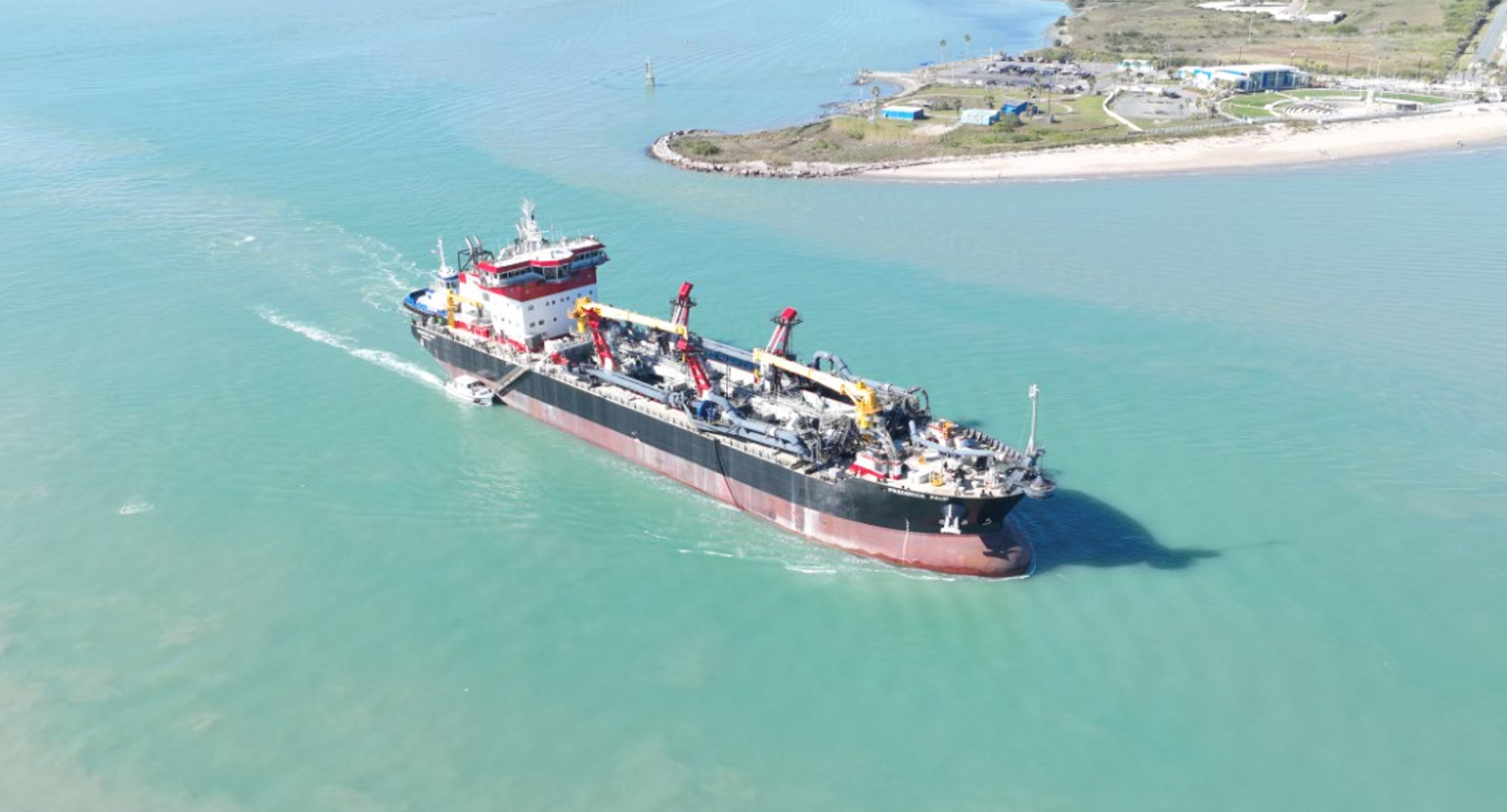
The hopper dredge Frederick Paup made history when it entered service in early 2026.
At 419 feet 10 inches long and 81 feet wide, she is the largest U.S.-flagged, self-propelled hopper dredger built in American maritime history.
This latest addition to Manson Construction’s fleet is purpose-built to maintain and improve the navigability of waterways and harbors, something most of us never notice but which is essential to global shipping and supply chains.
And while corrosion protection is critical for any working vessel, it’s especially important—and made more challenging—considering the singularly abusive conditions in which dredgers operate.
It’s not something you phone in. Instead, Manson phoned an old friend.
Hopper dredges take a beating
Frederick Paup is big.
Its 15,000 cubic yard capacity is the highest of any American hopper dredger, breaking a record that another Manson vessel, Glenn Edwards, set when it was laid down in 2006.
In fact, in many ways, Frederick Paup is the next chapter in a story that Manson began with the construction of Glenn Edwards. In addition to the increased hopper capacity, Frederick Paup is almost 30 feet longer and five feet wider than its predecessor. Its state-of-the-art Tier 4-compliant diesel/electric engines reduce total emissions. And other design modifications emphasize Manson’s endless pursuit of improving crew safety.
What hasn’t changed is the heavy duty and severely corrosive service environment in which the vessel must operate. And to understand why that service is so abusive, it pays to know how trailing suction hopper dredgers work.
Lengths of piping slung from the vessel’s port and starboard sides are dropped to the seabed. At the business end of each, big steel scoops scour the seabed to loosen sand and silt. Powerful pumps suck a mixture of the loosened material and water up through the large piping and deposit it in the hoppers.
From there, the material is either simply dumped on the sea floor somewhere out of the way, or it’s reclaimed for use in marine construction or coastal land restoration projects.
Just as hopper dredgers are purpose built for their specific role, the coating systems that protect them must be purposefully selected for the unique exposures and operating conditions aboard these heavy-duty vessels. Considerations include:
- • Constant immersion of the hull in seawater
- • Combined seawater, salt spray, and UV light exposure of exterior surfaces above the water line
- • Presence of heavy equipment on deck that poses a risk of mechanical damage
- • Chemical and physical exposures common in engine rooms, storage areas, and crew quarters
- • The combined corrosive and abrasive environment for the trailing suction arms, piping, and storage hoppers
Such a variety of service environments makes for a complex protective coating specification involving different products and systems for different service environments.
Executing on a complex spec is challenging enough, but the task of protecting this vessel became even more complicated as its construction and coating application coincided with a coatings and raw materials shortage in 2021, on the heels of the COVID-19 pandemic.
“I trust Brent 100%”
This wasn’t the first time Manson called Brent Arceneaux.
Shipyards up and down the Gulf have Brent, an experienced Carboline technical sales representative, on speed dial.
Brent did what Manson and others have asked him to do dozens of times before: He digested the details of the coating spec and rewrote parts of it when necessary. This requires equal measures of knowledge of corrosion and coatings as well as of the customer’s unique requirements.
And Brent knew those requirements very well indeed. Prior to joining Carboline, Manson Construction wrote Brent’s paychecks and Brent wrote the coating specs for much of the company’s fleet.
Jordan Brown, the Manson project manager overseeing construction of Frederick Paup, said that Brent’s knowledge and experience saved everyone involved a lot of trouble during a period of extreme supply chain uncertainty in the wake of the pandemic.
“Brent has the experience to tell me the benefits of certain coatings versus others in situations that may require substitutions. I can call him at any time for a product question or an application question, and he always has an answer,” Jordan said. “He is very familiar with Carboline’s supply chain, which is critical for mapping out large paint orders. And he offered accelerated substitutions during the industry-wide paint shortages in 2021.”
Paint crews in the fabrication shop where sections of the Frederick Paup were built appreciate Brent, too.
“One example is the glass flake paint (Carboguard 1209), which can be difficult to apply. Brent offered tips for spraying that we could provide our fabricators with. And with the deck paint and non-skid grit, he offered application techniques that cannot be found on a product data sheet,” Jordan said. “You only pick those things up from experience.”
“So I trust Brent 100%. He has not let me down once.”
Coating systems aboard Frederick Paup
The below summary of coating systems applied to Frederick Paup demonstrates the depth and complexity involved in protecting large seagoing vessels.
Hull keel to waterline:
- • One coat of Carbomastic 15 surface-tolerant, lamellar-aluminum flake reinforced epoxy primer
- • One coat of Carboguard 235 phenalkamine surface-tolerant epoxy developed for fresh and salt water immersion
- • Two coats of C-Flex 45 multi-season antifouling
Waterline to deck edge and cap rails:
- • One coat of Carbozinc 808 rapid-curing, reinforced zinc-rich primer
- • One coat of Carbomastic 15 high-solids mastic with lamellar aluminum pigment superior barrier protection
- • One coat of Carboguard 890 epoxy mastic finish featuring excellent chemical resistance and rated for immersion service
Exterior superstructure:
- • One coat of Carbozinc 808
- • One coat of Carbomastic 15
- • One coat of Carbothane 134 HG thin-film, high-gloss urethane finish with outstanding weathering properties
Deck, pump room, and drag arms:
- • One coat of Carbomastic 15
- • One coat of Carboguard 1209 high-density, flake-reinforced polyamido-amine epoxy coating ideal for severe marine exposures, with Filler 47 non-skid aluminum oxide aggregate filler
- • One coat of Carboguard 890
Hopper interiors and gates:
- • One coat of Carbomastic 15
- • One coat of Carboguard 1209
Machinery spaces:
- • Two coats of Carboguard 635 all-purpose immersion-grade epoxy featuring good surface and moisture tolerance
- • One coat of Carbothane 134 HG
Voids, ballast tanks, and potable water tanks:
- • Two coats of Carboguard 635
Exhaust pipes:
- • One coat of Carbozinc 11 inorganic zinc-rich primer featuring exceptional corrosion protection and high temperature resistance
- • One coat of Thermaline 4700 high-temperature finish coat
Day-to-day inventory management
Lee Roy Navarro was in the middle of it all.
Frederick Paup was built at the AmFELS shipyard in Brownsville, Texas. Lee Roy’s neck of the woods.
With huge quantities of all those different SKUs, Manson, AmFELS, Carboline, and third-party coating contractors all knew that close local support was essential.
That came from Lee Roy, a long-time Carboline sales representative based in south Texas. His job was to keep the paint crews supplied with what they needed when they needed it. He described this as “building inventory locally.”
The description is too modest. Lee Roy had to know the present and see the future at once. That meant keeping up with the progress crews were making and walking the yard to see it for himself when necessary.
Clear communication and staying organized were essential. “At its most, they probably had 50 painters between three subcontractors and some of AmFELS’ own personnel,” Lee Roy said. Knowing the day-by-day progress was the only way he could get the ball rolling on ordering, making, and shipping the right amounts of the right products. That’s tough under normal circumstances, and very challenging on the heels of a supply chain crisis.
Value beyond what’s in the bucket
Even in the best of times, no large, complex construction project goes perfectly.
And the early 2020s were especially difficult years for builders. Circumstances seemed to conspire against anyone relying on predictability in global supply chains. Everyone was adrift.
But not the team building Frederick Paup. Advance specification collaboration and on-site shipyard support were essential to a successful coating installation.
Frederick Paup left the shipyard for its inaugural assignment in January 2026.